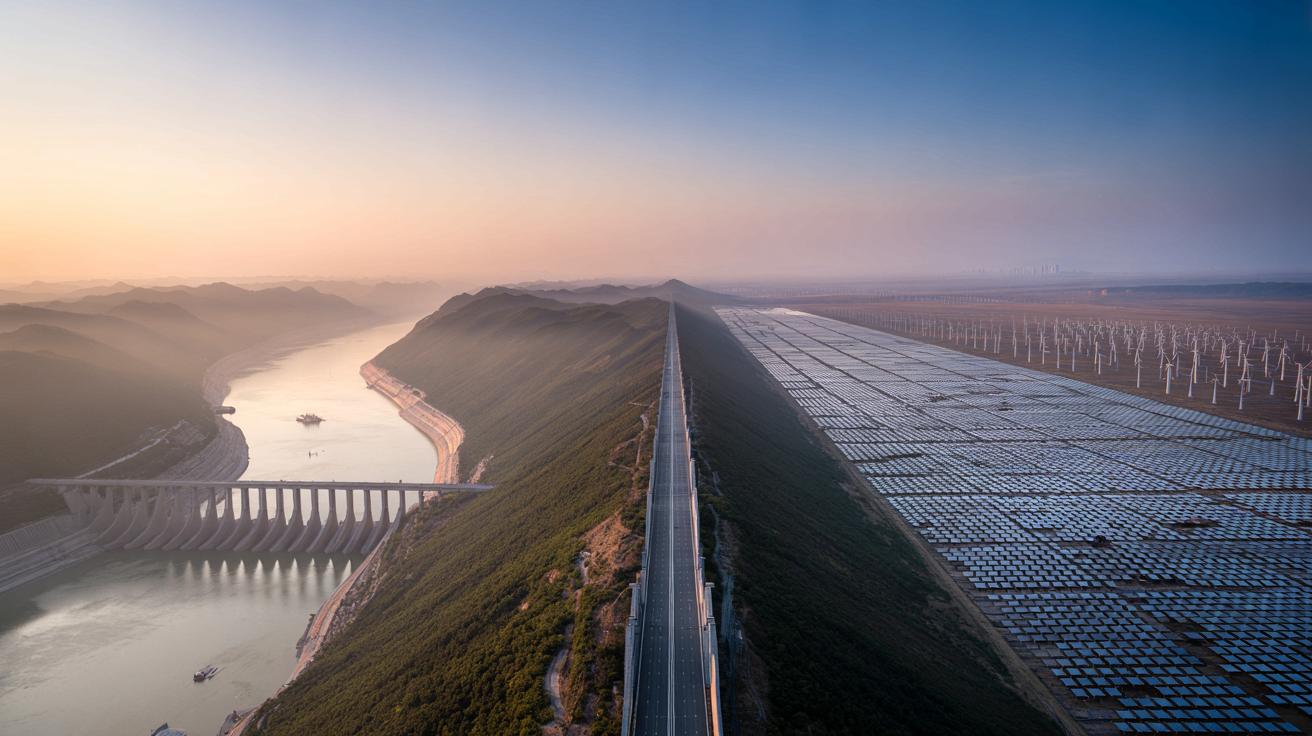
On the screen in front of me, the satellite images look almost unreal. A huge grey ribbon cuts across the Yangtze River, holding back a sea of water that seems to glow in the morning haze. Somewhere behind those pixels lies the Three Gorges Dam, so massive that scientists say its reservoir can literally slow the rotation of the Earth by a tiny fraction of a second.
And yet, while the world is still digesting that idea, China has quietly rolled out something even bigger in ambition. Different shape, different landscape, same dizzying sense of scale.
You get the feeling we’re watching a country that has decided to play with the planet’s settings.
From a dam that nudges Earth’s rotation to an energy project on another scale
Standing on the viewing platform above the Three Gorges Dam, tourists usually do the same thing. They lean on the rail, squint at the endless water, and then try to fit what they see into a phone screen that’s simply too small. The numbers are hard to digest: more than 2 kilometers long, over 180 meters high, a reservoir stretching some 600 kilometers through the mountains.
This is the dam that once flooded entire valleys, displaced more than a million people, and reshaped one of Asia’s great rivers. It also shifted billions of tons of water into one place, altering the distribution of mass on Earth just enough to lengthen the day by about 0.06 microseconds. Tiny on paper. Enormous when you think about the scale.
When the reservoir first filled up, NASA scientists ran the numbers and came back with a surreal conclusion. The water stored behind Three Gorges slightly changed the planet’s moment of inertia, the same principle that makes a spinning skater slow down when they stretch out their arms. Our days grew a hair longer, our axis tilted a fraction of a fraction of a degree.
No one felt it, of course. No alarm went off, no clocks failed. Life went on, traffic jams remained traffic jams. Yet the symbolism stuck. Humanity had built something so heavy, so wide, that it left a fingerprint on the planet’s movement through space.
That fingerprint was only a hint of what was coming next. Because while the world debated the dam’s social and environmental costs, Beijing’s planners were already sketching an energy strategy that would reach far beyond one river. The new obsession wasn’t just about controlling water, but about capturing the raw forces of sun, wind and gravity on a continental scale.
The latest project, often called the “ultra mega” clean energy base in the Gobi and surrounding deserts, is not a single structure like a dam. It’s a web. Solar farms the size of cities, wind turbine forests marching over dunes, hydropower stations downstream acting as mega batteries. It’s less visible from a tourist platform, but on a global map, the patch of China it covers looks almost unreal.
China’s new mega-project: a hybrid energy machine in the desert
Think of a place where the horizon is mostly empty: dry plains, sand, low hills. Now imagine that same landscape slowly filling with solar panels aligned like metal waves, and rows of wind turbines turning above them like giant metronomes. This is what is happening in regions like Inner Mongolia, Xinjiang and the Gobi fringe, where China is building what officials call “large-scale wind-solar hybrid bases”.
➡️ The must-have hot drink in January: it cleanses the pancreas and prevents fatigue
➡️ Bosch finally explains how fridge magnets affect your electricity bill
➡️ Meteorologists confirm that the jet stream will realign unusually early this January
➡️ China’s new 22 km tunnel marks an engineering miracle and a controversial monument to state power
The plan announced in recent years aims for hundreds of gigawatts of new capacity, much of it already under construction. Some single clusters exceed 10 GW each, more than the total power capacity of entire countries. It’s grandiose, a bit unsettling, and undeniably strategic.
On the ground, the scenes are almost science fiction. Workers bolt down endless solar modules, trucks trace geometric grids in the dust, and high-voltage towers march toward the horizon. One flagship complex in Inner Mongolia alone is slated to reach around 16 GW of mixed wind and solar capacity, paired with transmission lines that run thousands of kilometers to the industrial heartlands on the coast.
Local farmers describe how the sky has filled with blades and cables where there used to be only flocks and scrub. Young technicians arrive from distant cities, living in prefab camps, coding algorithms that decide when to send power to Beijing, when to store it in pumped-hydro reservoirs, and when to feed it into giant batteries.
Behind this desert machinery lies a very simple logic. China burns more coal than any other country and still wants its factories, subways and data centers running 24/7. The only way to square that with climate pledges is to flood the grid with renewables at a pace no one else has tried. So instead of just one monumental object like Three Gorges, the new approach is a distributed monster: thousands of turbines, millions of panels, stitched together by some of the world’s longest ultra-high-voltage lines.
This is why many experts say the new mega-bases are “more impressive” than the dam. They don’t just bend a river; they start to bend the logic of an entire energy system. *A single dam slows the planet by micoseconds; a continent-scale clean grid could change how civilization spins.*
What this gigantic project actually changes for the rest of us
From a practical point of view, these mega-bases are a test of something every country secretly wonders: can an economy really run on unpredictable sun and wind without falling apart? China’s method is blunt but revealing. Build huge clusters in the best locations, connect them with the strongest possible transmission lines, and back them up with dams and storage that behave like giant shock absorbers.
For people watching from Europe, Africa or the Americas, this is a kind of live laboratory. Failures will be spectacular, but so will the lessons.
We’ve all been there, that moment when a big climate promise sounds great on a conference stage and then crashes into the daily grind of bills, traffic, and weather. Beijing’s engineers are facing the same collisions, just at a terrifying scale. When clouds roll over a desert solar farm or the wind drops at night, the grid flickers, factories complain, and someone gets a phone call at 3 a.m.
Let’s be honest: nobody really does this every single day with perfect control. There are curtailments, wasted power, sections of the network that can’t absorb all the electricity yet. The human side is messy, with local protests, land use disputes, and technicians quietly improvising to keep things running.
“People talk about the Three Gorges because it’s visible,” a Chinese energy researcher told me during an online briefing. “The new bases are different. They’re less of a monument and more of a machine that never really stops changing.”
- Three Gorges as a symbol
A single mega-dam that became a global reference point for human influence on the planet. - Desert energy bases as a system
Sprawling networks of solar, wind and hydro turning whole regions into power engines. - What this means for readers
A preview of how future grids may look in your own country: more spread out, more digital, and more dependent on landscapes we rarely visit.
A new kind of planetary engineering we’re only starting to grasp
The strange thing about these projects is how quickly they slip into the background. Today, a dam shifting Earth’s rotation sounds like a wild fact to drop at dinner. Tomorrow, a solar complex the size of a European capital might feel routine, just another satellite image scrolling past your feed.
Yet each of these structures quietly rewrites the contract between our species and the planet. We’re no longer just adapting to mountains, rivers and deserts; we’re rearranging them to match our schedules, our production cycles, our need for constant connection.
From a climate perspective, the desert mega-bases are a paradox. They are built to reduce emissions, but they depend on concrete, steel, rare metals, and huge construction footprints. For local communities, they can bring jobs and roads, but also noise, dust, and lost grazing land. For the rest of the world, they set a pace that is both inspiring and intimidating: if one country can roll out hundreds of gigawatts in a handful of years, what excuse does anyone else really have?
The story doesn’t have a neat ending. New technologies, new political tensions, new climate shocks will keep reshaping these plans. And somewhere between a dam that slows the planet and a desert turned into a power plant, we’re left with a simple question: how much of the Earth are we willing to redesign so that our lives can keep spinning the way we like?
| Key point | Detail | Value for the reader |
|---|---|---|
| Three Gorges Dam’s scale | So massive its reservoir slightly lengthens Earth’s day | Grasp how far human infrastructure already reaches |
| New desert mega-bases | Hundreds of gigawatts of hybrid solar-wind projects linked by ultra-high-voltage lines | Understand why this project may matter more than a single dam |
| Future of energy systems | Shift from iconic objects to vast, flexible networks combining renewables and storage | Anticipate how power grids and landscapes around you might evolve |
FAQ:
- What is the Chinese dam that can slow Earth’s rotation?The Three Gorges Dam on the Yangtze River, whose enormous reservoir slightly changes Earth’s distribution of mass, lengthening the day by around 0.06 microseconds.
- How can a dam affect the planet’s rotation?By storing billions of tons of water in one place, the dam alters Earth’s moment of inertia, similar to how a spinning skater slows when stretching out their arms.
- What new project is considered “even more impressive”?A series of gigantic clean energy bases in desert and steppe regions, combining solar, wind and hydropower, linked by ultra-high-voltage transmission lines across China.
- Why are these desert mega-bases such a big deal?They could add hundreds of gigawatts of low-carbon power, testing at huge scale how a modern economy can rely heavily on variable renewables.
- Will other countries follow this model?Many are watching closely. While few can match China’s pace or central planning, large hybrid renewable hubs and long-distance grids are already being discussed in regions from the Middle East to South America.