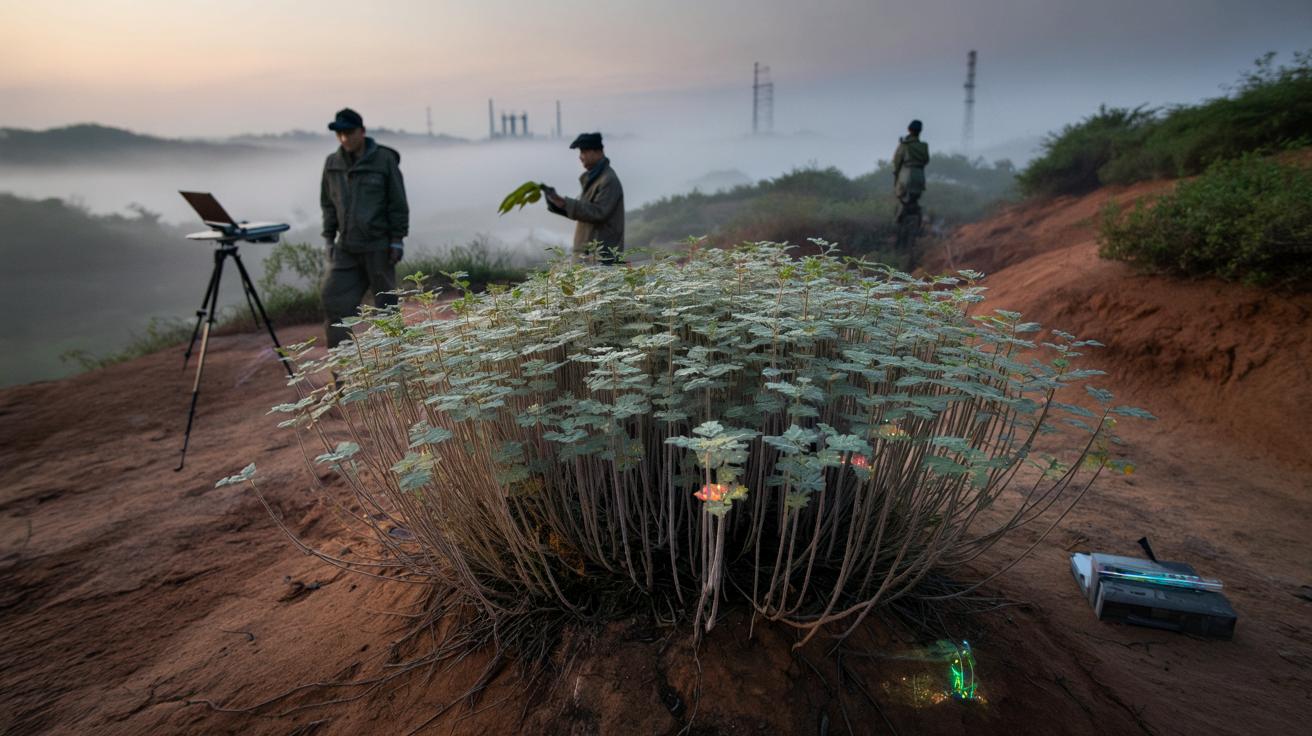
On a foggy morning in southern China, a group of scientists stands in a hillside field that looks painfully ordinary. Red-brown soil, scrubby bushes, a few spindly trees. But in the middle of it all grows a patch of small, unremarkable plants with slender stems and narrow leaves. From a distance, they’re almost invisible. Up close, they might just change the balance of global power.
The researchers snip a few leaves, slip them into plastic bags, and head back to their lab. A few hours later, the results blink on a computer screen: the plant’s tissues are loaded with rare earth elements – the metals that power smartphones, electric cars, and military radars.
One modest-looking shrub, quietly pulling strategic metals out of the ground.
A quiet plant in the Chinese hills that could shake the world
The plant has a name that sounds more like a lab code than a headline: Phytolacca acinosa, a kind of pokeweed. It doesn’t glow, it doesn’t smell like chemicals, it just stands there. Yet this humble species has stunned scientists because it can “hyperaccumulate” rare earths from the soil at levels rarely seen in nature.
Imagine a living vacuum cleaner for strategic metals, growing by the roadside. That’s essentially what Chinese researchers stumbled upon while studying polluted mining areas in Jiangxi province. They weren’t hunting for a geopolitical game-changer. They were trying to rehabilitate toxic land.
According to early studies from Chinese research teams, the leaves of this plant can hold rare earth concentrations dozens of times higher than typical vegetation in the same area. In some samples, the biomass was so loaded with elements like yttrium and lanthanum that it almost read like a low-grade ore.
One agronomy student who joined a field mission recalled her surprise: what looked like a weed on an eroded slope turned out to be worth more, gram for gram, than some mined rock. Stories like hers are now spreading quietly across Chinese science circles. The plant is no longer just a curiosity. It’s a potential tool.
The logic is brutal and simple. Rare earth metals are essential for green tech, missiles, wind turbines, high-performance magnets. Mining them is dirty, expensive and politically sensitive. If you can plant a cheap, fast-growing crop that concentrates these metals, you change the rules of the game.
China already dominates the rare earth supply chain, from mining to refining. A biological shortcut that lets it “farm” metals on contaminated soils, or even on marginal land, only amplifies that lead. And that’s where the anxiety begins, from Washington to Brussels and Tokyo. The fear is not science fiction. The fear is leverage.
From green clean-up tool to new front in a resource race
In the lab, the method looks almost disarmingly simple. First, you identify soils rich in rare earths, often areas scarred by previous mining or heavy industry. Then you plant Phytolacca acinosa, or other hyperaccumulator species that Chinese botanists are now hunting for across the country. The plants grow, drink in water and nutrients – and quietly absorb rare earth ions along the way.
➡️ China’s new 22 km tunnel marks an engineering miracle and a controversial monument to state power
➡️ Bosch finally explains how fridge magnets affect your electricity bill
➡️ The must-have hot drink in January: it cleanses the pancreas and prevents fatigue
➡️ Meteorologists confirm that the jet stream will realign unusually early this January
After a few months, you harvest the biomass, dry it, and send it to processing facilities. Instead of digging open pits and blasting rock, you let chlorophyll do the hard work. It’s slow, yes. Yet it’s cheaper, cleaner and, crucially, easier to scale discreetly.
We’ve all been there, that moment when a simple trick suddenly outperforms a complicated machine. That’s the unsettling part for Western strategists watching this story unfold. They’ve been investing in new mines, alternative refineries, recycling technologies. Meanwhile, a quiet experiment in the Chinese countryside suggests that fields of plants could, over time, supplement or even partly replace some forms of mining.
Let’s be honest: nobody really checks what’s growing on the edge of an industrial zone, or on a scarred hillside in a remote county. That’s exactly where such crops can thrive, under the radar, turning “wasted land” into a strategic asset. And for once, the word “green” means both ecological and geopolitical.
Analysts who follow resource politics see this as part of a broader pattern. Beijing has been explicit about using biology, from GMO crops to fast-growing trees, to secure food and materials for the long term. Rare-earth-absorbing plants fit neatly into that doctrine. They clean up contaminated landscapes, earn local governments environmental points, and generate a high-tech raw material at the same time.
*What turns this from clever science into a potential flashpoint is timing.* The world is scrambling to electrify cars, build batteries, and modernize militaries, all hungry for rare earths. Any technology that strengthens a single supplier’s hand in this race becomes instantly political, whether scientists like it or not.
Between opportunity and fear: how this discovery might actually be used
The most constructive path is almost counterintuitive: cooperate, at least partly. Chinese labs are not the only ones capable of working with hyperaccumulator plants. European and American researchers have already identified species that absorb nickel, cadmium, even gold. Extending that research to rare earths, and testing joint projects in contaminated zones worldwide, could spread both the know-how and the leverage.
One practical gesture policymakers could take is to support pilot fields outside China, from old mining sites in Eastern Europe to abandoned industrial plots in the US. Start small. Measure yields. Track the real cost per kilogram of metal recovered. Turn the hysteria into data.
People reading about this plant often jump straight to the nightmare scenario: endless secret plantations, quiet hoarding of metals, a new form of “green colonization” through seeds instead of soldiers. The fear is understandable. So is the temptation to ban or restrict such crops, at least on Western soil.
The trouble is, biology crosses borders whether we like it or not. Seeds travel, knowledge leaks, and once a technique proves profitable, someone will adopt it. A more grounded response would be to avoid two classic mistakes: panicking publicly, which only increases the sense of dependence, and neglecting our own soil science, which quietly deepens it. Anxieties don’t disappear because we look away.
Chinese ecologist Liu Yong, who has worked on metal-absorbing plants, reportedly told colleagues during a closed seminar: “The world sees this as a weapon. I see land that can breathe again. But we all know strategic value is never far behind any green technology.”
- Do not underestimate “boring” plants: unremarkable weeds are often the species that survive in toxic ground and evolve metal-absorbing tricks.
- Avoid seeing biology as magic: phytomining is slow, land‑hungry, and rarely a silver bullet.
- Watch the processing stage closely: the real edge comes not just from growing the plants, but from efficiently extracting the metals from their biomass.
- Support transparent field trials: shared data on yields, costs and environmental impact can blunt the sharpest geopolitical fears.
- Remember local communities: if fields of metal-rich crops appear, someone will be working them, and their story will matter as much as the export figures.
What this strange plant really tells us about power, tech and the ground beneath our feet
The discovery of a plant that sips rare earths from the soil is not a Marvel plot twist. It’s a reminder that raw power still starts in the ground, even in a hyper-digital age. While we argue over apps and algorithms, someone is kneeling in a field, cutting stems that carry the future of electric motors and guided missiles inside their veins.
One emotional frame runs quietly through this story: the sense that everyday landscapes are no longer neutral. A hillside in China, a slag heap in France, a tailings pond in the US – all become potential “green mines” in a world that cannot get enough strategic metals. That feeling doesn’t show up on commodity charts, yet it shapes how nations talk to each other.
If there is a small chance in this unsettling tale, it’s that plants don’t care who owns them. Seeds can be shared, methods can be replicated, mining scars can be healed, not just exploited. The real question is whether the race for rare earths pushes us to plant walls or to plant fields. The answer, as always, will not just come from labs and ministries, but from the quiet choices made on forgotten pieces of land.
| Key point | Detail | Value for the reader |
|---|---|---|
| Plant “phytomining” potential | Certain species like Phytolacca acinosa can absorb high levels of rare earths from soil | Helps you grasp why a simple plant suddenly matters for tech, energy and defense |
| China’s strategic advantage | Existing dominance in rare earth mining and refining could be reinforced by biological methods | Clarifies why this discovery raises talk of a new resource war and supply dependence |
| Possible responses | Invest in similar research globally, launch transparent field trials, focus on cleanup plus extraction | Shows realistic ways countries and citizens can push for solutions that are greener and less risky |
FAQ:
- Question 1Is this rare‑earth‑absorbing plant genetically modified?
- Answer 1Current reports suggest Phytolacca acinosa is a naturally occurring species that happens to tolerate and accumulate rare earths in contaminated soils. Researchers are studying its genetics, but the plant itself is not known as a lab‑created GMO.
- Question 2Could these plants replace traditional rare earth mines completely?
- Answer 2Unlikely in the short term. Phytomining is slower and depends on land area and climate. It could supplement mining, clean up polluted sites, and provide niche supplies, rather than instantly replacing large-scale extraction.
- Question 3Should we be worried about a new kind of “green” resource war?
- Answer 3The discovery adds one more tool to China’s rare earth toolbox, which raises strategic concerns. But the same science can be developed elsewhere, and transparent collaboration could ease tensions instead of escalating them.
- Question 4Can other countries use similar plants on their own contaminated land?
- Answer 4Yes. Many nations have metal‑tolerant plants. With targeted research, they can identify local species or introduce controlled crops to recover metals while restoring damaged ecosystems.
- Question 5Is it safe to grow and handle these plants?
- Answer 5The plants themselves are not radioactive or visibly dangerous, but their tissues can contain high metal concentrations. Workers would need basic protective measures, and the harvested biomass should be treated as industrial material, not ordinary farm waste.