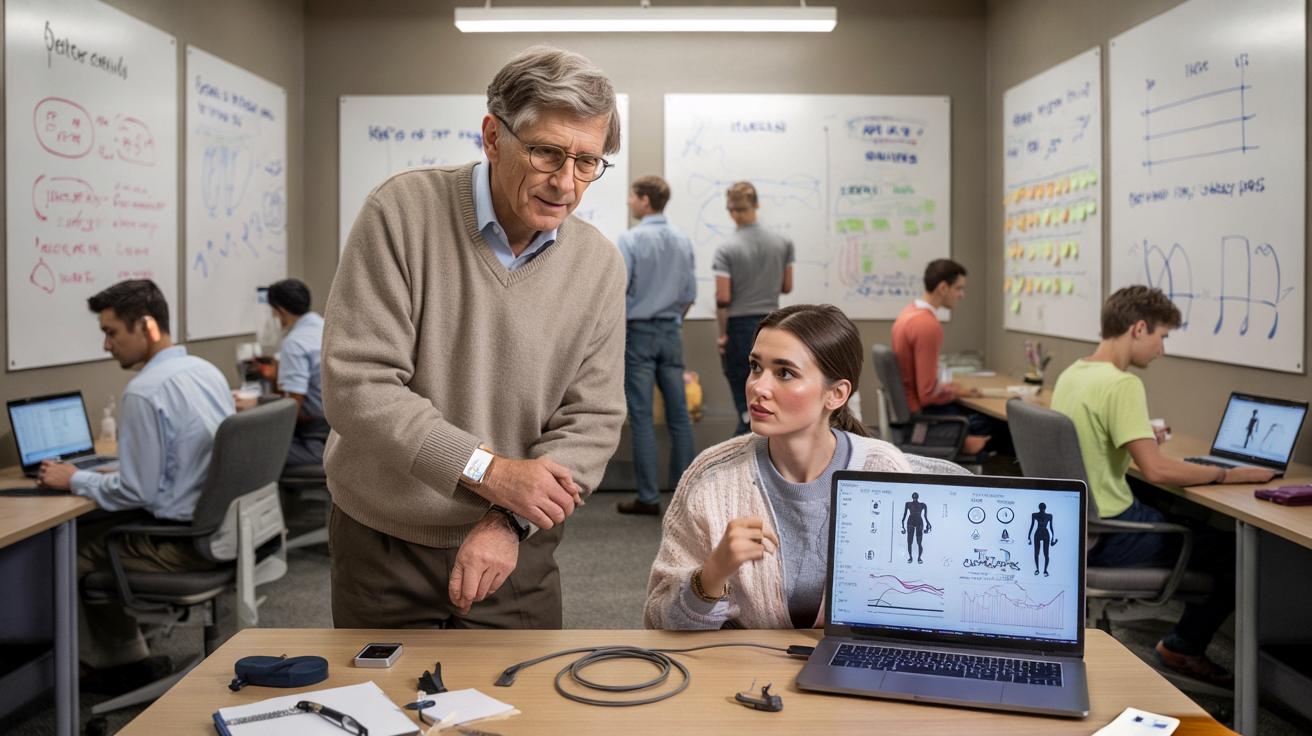
On a gray Seattle morning, a few engineers in a tiny biotech office looked up from their laptops and did a double take. The older guy quietly helping move chairs before a team meeting looked familiar. Hands in pockets, sweater slightly too big, asking where the HDMI cable was. Then someone whispered: “You know that’s Bill Gates… right?”
He wasn’t there to speak on a stage or cut a ribbon. He was there to work. To sit in meetings. To review slides. To understand, from the ground, what his daughter Phoebe is building with her startup in women’s health and sports performance.
No entourage. No velvet rope. Just one of the most famous CEOs on the planet, retired from Microsoft, choosing to spend time on the front line again.
That choice says a lot.
When a retired giant walks into a tiny office
There’s a strange energy when a legendary leader steps into a small startup. People straighten their backs. Jokes get filtered. The air gets dense, like before a storm. When Bill Gates started showing up at his daughter’s startup, reporters focused on the “cute family angle”. Father supporting daughter. Billionaire hanging out in a modest workspace.
But look past the soft-focus story and you see something sharper. A man who once ran a company with more than 100,000 employees, choosing to sit in a room where the agenda is not his. Listening to product updates from twenty-somethings. Asking frank questions about menstrual cycles, hydration sensors, or training loads. Accepting that, in this room, he’s not the CEO. He’s a learner again.
This is not Gates dropping by once for a photo op. People on the team talk about him actually being present. Joining meetings. Giving feedback on strategy. Asking for data, not just grand visions. He’s there for the unglamorous parts: the messy whiteboard sessions, the “this didn’t work” post-mortems, the nervous rehearsals before a pitch.
There’s a clear image: one of the world’s most famous tech founders leaning forward in a basic office chair, squinting at a graph about hormonal variations in female athletes. That’s not PR. That’s curiosity. And it’s a quiet reminder to a lot of comfortable executives that leadership isn’t just about town halls and shareholder letters.
It’s about being physically where the real work happens, even when no one is filming.
Why does that matter? Because distance kills companies. The bigger the title, the thicker the walls of PowerPoint and filtered reports. Many CEOs today don’t use their own product the way a normal user does. They hear about “churn” and “engagement” as numbers, not as real people frustrated on a Tuesday night at 11:47 p.m., app crashing before payment.
➡️ Meteorologists confirm that the jet stream will realign unusually early this January
➡️ China’s new 22 km tunnel marks an engineering miracle and a controversial monument to state power
➡️ Bosch finally explains how fridge magnets affect your electricity bill
➡️ The must-have hot drink in January: it cleanses the pancreas and prevents fatigue
By sitting in his daughter’s startup, Gates is modeling the opposite. He’s saying: if you want to understand where the world is going, you sit with the people building it from scratch. You listen to the clumsy first versions, not just the polished deck for investors. You let reality contradict your assumptions. *That’s the muscle a lot of leaders quietly lose after decades at the top.*
Front-line leadership in a hoodie, not on a stage
So what does “being on the front line” actually look like when you’re a CEO or a senior leader, not a retired billionaire dropping by your kid’s startup? It can be embarrassingly simple. Sit in customer support once a month. Spend half a day on the factory floor. Work from the sales team’s open space instead of your office. Use your own product for a full week as if you were a new customer, without special access or shortcuts.
Gates, by showing up in his daughter’s early-stage company, is doing a version of this. No VIP version of the experience. No executive filter. Just immersion. CEOs don’t need a famous last name to copy that. What they need is the humility to say, “I don’t understand enough. I need to go where the information is raw.” When a leader does that, the whole organization feels it. The distance shrinks.
Here’s where it often goes wrong. Many executives only visit the front line when there’s a crisis or a camera. They show up, shake hands, give a short speech, and disappear. Everyone knows it’s theater. The “real” work, the sweaty, repetitive, sometimes boring stuff, goes back to being invisible. People on the ground stop expecting to be heard.
We’ve all been there, that moment when the boss arrives for a walk-through and suddenly the place looks like a showroom. Angry customers get pushed aside. Real conversations stop. And then leadership wonders why their decisions feel disconnected from reality. Let’s be honest: nobody really does this every single day. But the leaders who do it regularly—quietly, without a hashtag—are the ones whose companies adapt faster when the market shifts.
There’s a deeper shift behind Gates’ choice that other CEOs would be smart to copy: moving from “expert on top” to “student in the room”.
Bill Gates once said that his favorite meetings were the ones where he left with more questions than answers. Watching him in his daughter’s startup is like watching that quote come to life.
He’s not there to dominate the discussion, he’s there to test his worldview against a new reality—women’s sport, wearable tech, hormonal health, data he didn’t grow up with at Microsoft.
That mindset is portable. Any leader can adopt it by turning front-line time into a protected ritual, not an exception. One simple approach is:
- Block a recurring “front-line session” in your calendar every two weeks.
- Pick one team, one store, one product area and just sit with them.
- Ask basic questions, even if they make you look uninformed.
- Write down what surprised you instead of what confirmed your beliefs.
- Bring one concrete change from those sessions into your next leadership meeting.
Done consistently, this shifts your role from distant decision-maker to engaged partner in reality.
The quiet revolution that starts at someone else’s desk
The scene of Bill Gates quietly working at his daughter’s startup sits in the mind like a little glitch in the matrix. The guy who shaped the PC era, now taking notes in a niche sports-tech meeting about female physiology. That image raises awkward questions for a lot of executives clinging to corner offices and carefully scripted all-hands.
Maybe the real badge of seniority now isn’t how far you are from the front line, but how close you’re willing to get back to it. Not for a tour, not for optics, but to genuinely be confused again. To hear things that make you uncomfortable. To sit in a room where the smartest person in the conversation is half your age and doesn’t have a title.
There’s also something deeply personal in this story that resonates beyond management theory. A father choosing to invest time, not just money, in the risky dream his daughter is building. Not as a controlling presence, but as an extra brain in the room. As leaders age, this kind of engagement—cross-generational, humble, curious—might be the most precious resource they can offer.
You don’t need a famous surname or a billion-dollar legacy to copy that. You just need the courage to close your laptop, stand up from your nice chair, and sit for a while where the problems are still unsolved and the PowerPoints haven’t yet smoothed the edges. The front line is rarely comfortable, but it’s almost always honest.
So the next time you see a viral clip of an executive giving a polished keynote, keep another picture in mind. A retired CEO carrying a laptop bag into a small office, greeting a product manager by first name, asking, “Okay, show me where the users are dropping off in the onboarding flow.”
That’s the kind of leadership that doesn’t trend on social networks, yet quietly shapes the future. The kind that says: status is nice, but context is oxygen. And that, before anything else, real authority starts with showing up where the work is still fragile, and sitting down.
| Key point | Detail | Value for the reader |
|---|---|---|
| Leadership needs proximity | Gates spending time in a small startup breaks the classic “corner office” model | Encourages you to move closer to the real work in your own role |
| Rituals beat one-off gestures | Regular front-line sessions work better than rare symbolic visits | Gives a concrete way to stay connected without burning out |
| Curiosity scales better than control | Arriving as a learner, not as the boss, unlocks better information | Helps you get honest feedback and spot changes earlier |
FAQ:
- Is Bill Gates officially part of his daughter’s startup?He’s not listed as a formal executive. His presence is more that of an advisor and active supporter, which actually makes his hands-on involvement even more striking.
- What exactly can other CEOs learn from this?The core lesson is that you never outgrow the front line. No matter your title, spending real time where the product meets the user is non-negotiable if you want relevant decisions.
- Do leaders risk micromanaging by being too close?The risk exists if you arrive to control. If you show up to observe, listen, and ask questions, proximity becomes insight, not interference.
- How often should a CEO be on the ground?There’s no magic number, but a recurring rhythm—once or twice a month in different areas—changes perspectives far more than one big annual tour.
- Can this work in remote or hybrid companies?Yes. “Front line” can mean joining live customer calls, sitting in on a feature-debug session, or shadowing a support chat shift, even via video. The key is unfiltered contact, not physical distance.