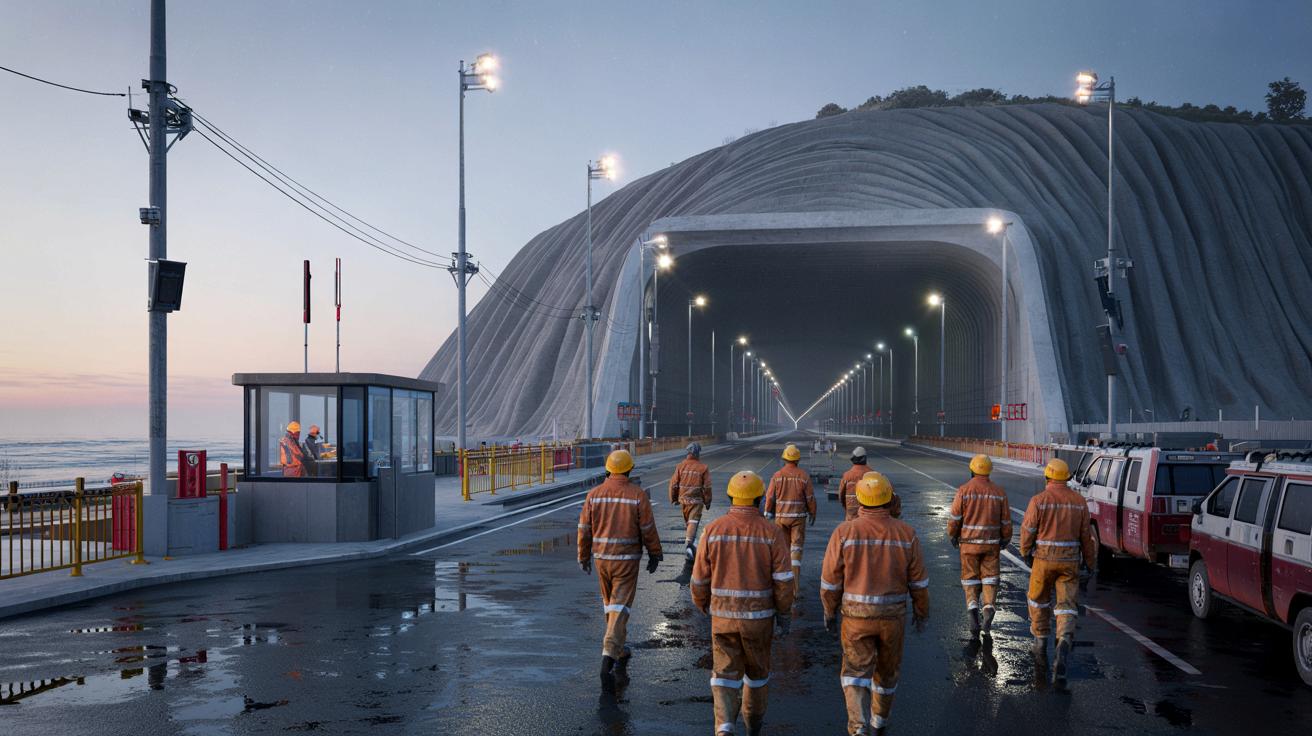
Dawn is barely a pale line over the mountains when the buses begin to arrive. Workers in orange vests file out in silence, helmets dangling from their hands, breath hanging in the air like ghosts. Below them, disappearing under the grey ribs of the hillside, stretches a black mouth of concrete that now runs for 22 kilometers under the sea. The new Bohai Strait tunnel — China’s latest mega-project — is still closed to the public, but its presence is already rearranging lives, traffic routes, and the political temperature in Beijing and far beyond.
Some stare at it with pride. Others see only a long, cold symbol of control.
Either way, nobody can ignore it.
Inside the 22 km giant under the sea
From the outside, the entrance doesn’t look like a miracle. A wide, squared-off portal. Cameras on high poles. The low buzz of generators and the deep, distant growl of ventilation fans. Then your bus rolls forward and the light snaps off, replaced by a tunnel ceiling dotted with lamps that seem to stretch on forever.
For the first minutes, you count the yellow stripes on the wall.
At some point, you stop, because your sense of distance gives up.
Engineers describe the Bohai Strait tunnel as a link, a clean line between Dalian and Yantai that cuts hours off the crossing. Locals describe it differently. A fisherman in Yantai jokes that the sea “now has a zipper.” A shopkeeper near Dalian says she’s already seeing delivery vans that didn’t use to come this way, drivers testing the new route like kids trying out a playground slide before the official opening.
In their stories, the tunnel is less about concrete and more about time.
Time to get to work. Time to get back home.
On paper, the numbers feel almost unreal. Over 22 kilometers of submerged tubes. Boring machines the size of small apartment blocks. A budget that quietly swallowed billions, plus a security system that tracks everything from water pressure to cell phone signals. *You can feel the weight of the state in every meter of this place.*
The government presents it as proof that China can still bend geography to its will.
Critics see a reminder that when Beijing wants something, there are few brakes left to pull.
Engineering miracle or monument to power?
Spend a few hours with the engineers on site and you sense a genuine, almost childlike pride. They swipe through photos on their phones: mud-splattered tunnel boring machines, flooded work shafts, night shifts where workers slept in buses because the concrete had to be poured before the next tide. One young project manager laughs as she shows a selfie, her face striped with grime.
She calls the tunnel “our dragon under the sea.”
For her, this is less about politics and more about leaving a mark on the map.
Outside the project zone, the conversation sounds slightly different. Environmental groups complain about the disruption to the seabed and the pressure on coastal ecosystems. Economists quietly ask if the country really needed another mega-project in the middle of a slowing economy and a real estate crunch. A taxi driver near Dalian shrugs and says that tolls will probably be too expensive for him anyway, that the tunnel “belongs to the bosses.”
We’ve all been there, that moment when a shiny new thing feels like it was never really meant for us.
That feeling sticks.
There is a plain-truth sentence that keeps echoing around this project: **big tunnels are never just about transport**. For Beijing, this 22 km line under the sea sends a message both inward and outward. Inward, it tells citizens that the state is still capable of grand, almost imperial works, even in uncertain times. Outward, it reminds neighbors and rivals that China is still willing to throw muscle and money at geography until geography yields.
The same concrete that carries trucks and trains also carries meaning.
You can’t pour one without pouring the other.
How China sells the tunnel to its own people
Look at the official posters and TV reports and a pattern emerges. The tunnel is framed as a family story, not a geopolitical one. A student hugging her grandfather at a train station, text reading “Now only 40 minutes apart.” A young couple watching the sea from a viewing platform, a sleek train disappearing into the distance. **The message is simple: this isn’t about steel and sovereignty, it’s about closeness.**
By putting human faces in front of mega-structures, the state softens the edges of power.
At least on screen.
People on the ground are not blind to the choreography. Many accept it, even like it, because the benefits are real: faster trade, new jobs, better logistics. Others roll their eyes at the patriotic music and carefully framed drone shots, saying it all feels “too clean” compared with the mud, delays, and night shifts they remember. Their complaint isn’t that the tunnel exists.
It’s that their messy reality gets edited out.
Let’s be honest: nobody really does this every single day, smiling faithfully at every new piece of propaganda they’re shown.
The double narrative comes out sharply when you listen to people off camera.
➡️ Bosch finally explains how fridge magnets affect your electricity bill
➡️ Meteorologists confirm that the jet stream will realign unusually early this January
➡️ The must-have hot drink in January: it cleanses the pancreas and prevents fatigue
“Without the state, this tunnel would never exist,” says one senior engineer, pausing beside a bank of monitors. “But without us,” he adds quietly, “the state would just have a plan on paper.”
- The official line: heroic workers, unified vision, glowing future.
- The private line: overtime, safety worries, whispers about budgets and contracts.
- The silent line: what it means when a government can drill anywhere, move anything, watch everyone.
In that gap between posters and private talk lives a more complicated story about pride, dependence, and quiet fear.
What this tunnel really says about the future
Walk back out of the 22 km tube and the daylight hits you with a small shock. For a second, it feels like stepping out of a movie and into a world that suddenly looks thinner, flatter, more fragile. The tunnel hums behind you, enormous and indifferent. Trucks will soon race through it, trains will whistle along its length, and the seabed above will keep pressing down with ancient, silent weight.
The question is not whether this project is an engineering miracle.
The question is who gets to decide what miracles are for.
| Key point | Detail | Value for the reader |
|---|---|---|
| Scale of the project | 22 km subsea tunnel across the Bohai Strait, linking major coastal hubs | Helps readers grasp why the tunnel is being called an engineering landmark |
| Political symbolism | Used by Beijing as proof of state capacity and national unity | Offers context for debates about infrastructure, power, and narrative |
| Human impact | Faster travel, new jobs, but also environmental worries and social tensions | Connects a distant mega-project to everyday lives and choices |
FAQ:
- Question 1Where exactly is China’s new 22 km tunnel located?It runs under the Bohai Strait, linking the port city of Dalian on the Liaodong Peninsula with the Yantai area on the Shandong Peninsula, closing a key gap between northern and eastern China.
- Question 2Why is this tunnel considered an engineering miracle?Because of its length, its subsea conditions, and the scale of the machinery and logistics involved, from massive boring machines to complex ventilation, drainage, and safety systems.
- Question 3What are the main criticisms of the project?Critics point to environmental damage, high costs during an economic slowdown, lack of transparency in contracts, and the use of the tunnel as a symbol of centralized state power.
- Question 4How will the tunnel change daily life for locals?It is expected to cut travel times dramatically, reshape freight routes, create new business opportunities, and possibly raise living costs around key access points.
- Question 5Is this tunnel part of a bigger political strategy?Yes, it fits into a broader push by Beijing to integrate regions, tighten control over strategic corridors, and showcase large-scale infrastructure as proof of national strength.