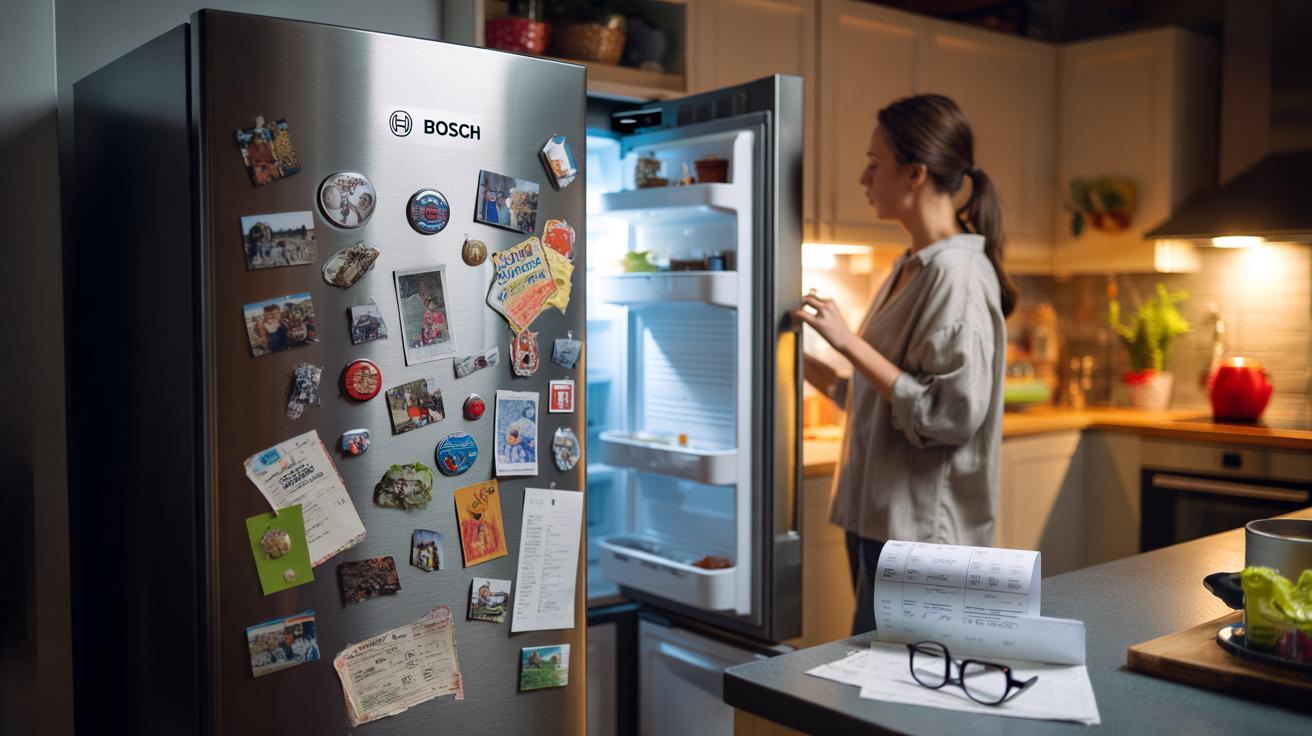
The family photos were starting to peel off the fridge. The souvenir magnet from Lisbon was sliding sideways, pushed by a heavy takeaway menu and three school timetables. When the electricity bill arrived, higher than the month before, Sophie did what many of us do: she blamed “the appliances”. The washing machine, the dryer, maybe the old freezer in the garage.
Then she stumbled across a Bosch customer Q&A and read a line that made her freeze in her tiny kitchen.
Could all those fridge magnets really be costing her money?
What Bosch really says about magnets and your fridge
Bosch engineers have been getting this odd question for years. “Do fridge magnets increase energy consumption?” It sounds like a joke, yet their answer has finally cleared the air. Their official position is simple: decorations stuck to the door don’t magically suck power out of the wall. The compressor doesn’t start whining louder just because your kid’s drawing is held by a panda magnet.
The myth comes from a basic confusion about how fridges work and what magnets actually do.
The fridge doesn’t care about your souvenir collection. It cares about temperature.
Still, the question kept popping up so often that Bosch ended up addressing it in service notes and on their help pages. One example: a German customer sent photos of a door literally tiled with magnets and postcards, asking if he needed to “strip it clean” to save power. Bosch support checked the model, ran tests in their lab, and came back with a calm answer: no measurable difference in consumption.
The only time they flagged a problem was when the door seal itself was cracked and dirty. That tiny strip of rubber, not the magnets, was the real money leak.
It was a classic case of blaming the wrong thing, just because it’s the one you see every day.
Technically, it makes sense. A fridge uses energy to move heat from the inside to the outside, through a closed circuit. The door is insulated, the walls are insulated, the compressor kicks in when the inside gets too warm. Magnets on the outside don’t interfere with that system. They don’t “fight” the fridge’s magnetic fields because domestic fridges don’t use magnetism to cool in the first place.
What can change energy use is anything that compromises temperature stability: a poor seal, a door opened too often, hot dishes shoved straight on the shelf.
The magnet myth survives because it feels intuitive: you see stuff cluttered on the door and assume the problem must be there.
Where magnets can play a sneaky indirect role
Bosch’s explanation gets subtler when you dig into real-life usage. The magnet itself doesn’t cost you a cent. What you attach with it might. Think about that overloaded door, drowned in takeaway menus and kids’ schedules. People tend to stand there, door wide open, reading, checking, deciding what to do next.
The fridge is leaking cold air the whole time, and the compressor will work harder right after.
Suddenly the “tiny” habit becomes a regular energy pattern.
One Bosch technician told me about a customer who swore their new A-rated fridge was “a scam”. Consumption was higher than expected, despite a modern, efficient model. When the technician visited, the first thing he saw was the door. A dense collage of papers, notes, recipes, all consulted like a vertical desk several times a day. The family would pause there, door open, debating meals or homework for a full minute.
On paper, the fridge was efficient. In practice, their habits quietly cancelled the label’s promise.
The magnets were innocent, but the way they were used was not.
Bosch’s internal guidance reflects that nuance. They don’t tell people to ditch magnets. They talk about “door open time” and “thermal loads”. Each second the door stays open lets warm, humid air in. That air has to be cooled back down, and moisture has to be managed by the system. More cycles, more wear, more electricity.
So the real danger is turning your fridge into a noticeboard you consult with the door gaping. Or covering the temperature display so you don’t notice when settings drift.
Magnets are just the stage props. The show is how you use the door.
Smart habits Bosch technicians actually recommend
The most effective advice from Bosch teams sounds almost too simple: treat the door like a quick hatch, not a window. Decide what you need before you open it. If you like using magnets for shopping lists, keep the list readable from the outside, at eye level, so you’re not tempted to swing the door open each time you add “milk” or “butter”.
Some technicians go further and suggest a tiny ritual: open, grab, close, then think.
Not very glamorous, but it quietly shaves minutes of open-door time over a week.
They also insist on watching what builds up on the seal. Food crumbs, hardened sauce, a bit of jam from a sticky jar – all of that can prevent the rubber from closing flush. The result is a thin, invisible air gap. Your fridge then runs more often to compensate for the constant mild leak. Let’s be honest: nobody really does this every single day.
Yet a quick wipe of the seal once a week saves far more energy than stripping every last magnet off the door.
The emotional trap is that we clean what we notice, and we notice colorful magnets more than a tired gray gasket.
Bosch engineers also warn about one specific mistake: heavy magnetic clips pinching the seal itself. If a big magnet bites into the rubber edge, it can deform the gasket over time. That doesn’t “use power” directly, it simply ruins the seal so the fridge works overtime to stay cold.
➡️ China’s new 22 km tunnel marks an engineering miracle and a controversial monument to state power
➡️ Meteorologists confirm that the jet stream will realign unusually early this January
“Magnets on the metal panel are fine,” one Bosch product specialist told me. “The only thing we don’t want is anything that distorts the door seal or stops the door from closing freely. Energy loss doesn’t start with decoration. It starts with a bad closure.”
- Keep magnets on the flat metal surface, away from the rubber seal.
- Use the outside of the door as a memo board, not the inside shelves.
- Clean the seal regularly; replace it if it’s cracked or no longer flexible.
- Check that paper or magnets never block the door from closing fully.
- Watch your “thinking time” with the door open – it adds up over a month.
What this small myth reveals about our energy anxiety
At the end of the day, the Bosch stance on magnets says as much about us as it does about fridges. We’re worried about bills, we’re bombarded with eco-advice, and we look for enemies we can control. Taking magnets off the door feels symbolic, almost like a diet for your kitchen.
Yet *the real savings often hide in dull, invisible places*: a clean condenser at the back, the right temperature setting, a door that closes cleanly every time.
The fridge magnets story exposes how easily we misread where energy is truly wasted.
Next time you’re in front of your fridge, maybe don’t rush to rip everything down. Look at how you use it instead. How long do you stand there with the door open? Is the seal intact, soft, without cracks? Is the back of the appliance dust-free so it can breathe?
The Lisbon magnet, the baby photo, the concert ticket from 2013 – they’re not the villains of your electricity bill.
If anything, they’re a reminder that your fridge isn’t just a box that cools food. It’s the emotional noticeboard of the home, quietly humming and consuming energy while life happens around it.
| Key point | Detail | Value for the reader |
|---|---|---|
| Magnets don’t directly use power | Bosch tests show no measurable consumption change from magnets on the door | Stops you wasting time and stress on the wrong problem |
| Door habits matter more | Long open-door times and a damaged seal raise energy use significantly | Gives you concrete levers to actually lower your bill |
| Small maintenance beats cosmetic gestures | Cleaning seals and condenser, checking closure, and avoiding seal pinching | Extends fridge life and cuts costs over months and years |
FAQ:
- Do fridge magnets really increase electricity consumption?According to Bosch, standard decorative magnets on the door do not directly increase energy use or affect how the cooling system works.
- Can strong magnets damage my Bosch fridge?Normal household magnets are fine on the metal panel; the risk comes only if heavy clips deform the rubber seal or physically block the door.
- Why do people think magnets affect the bill?The idea spread online, mixing up magnets with the fridge’s internal “magnetic” parts and confusing cause and effect around rising bills.
- What actually makes my fridge use more electricity?Warm room temperatures, frequent or long door openings, a worn or dirty seal, overfilling, wrong temperature settings, and dust-clogged coils.
- Should I remove all magnets to be safe?No. Use them sensibly on the flat door, keep them off the seal, and focus your effort on better habits and light maintenance instead.